
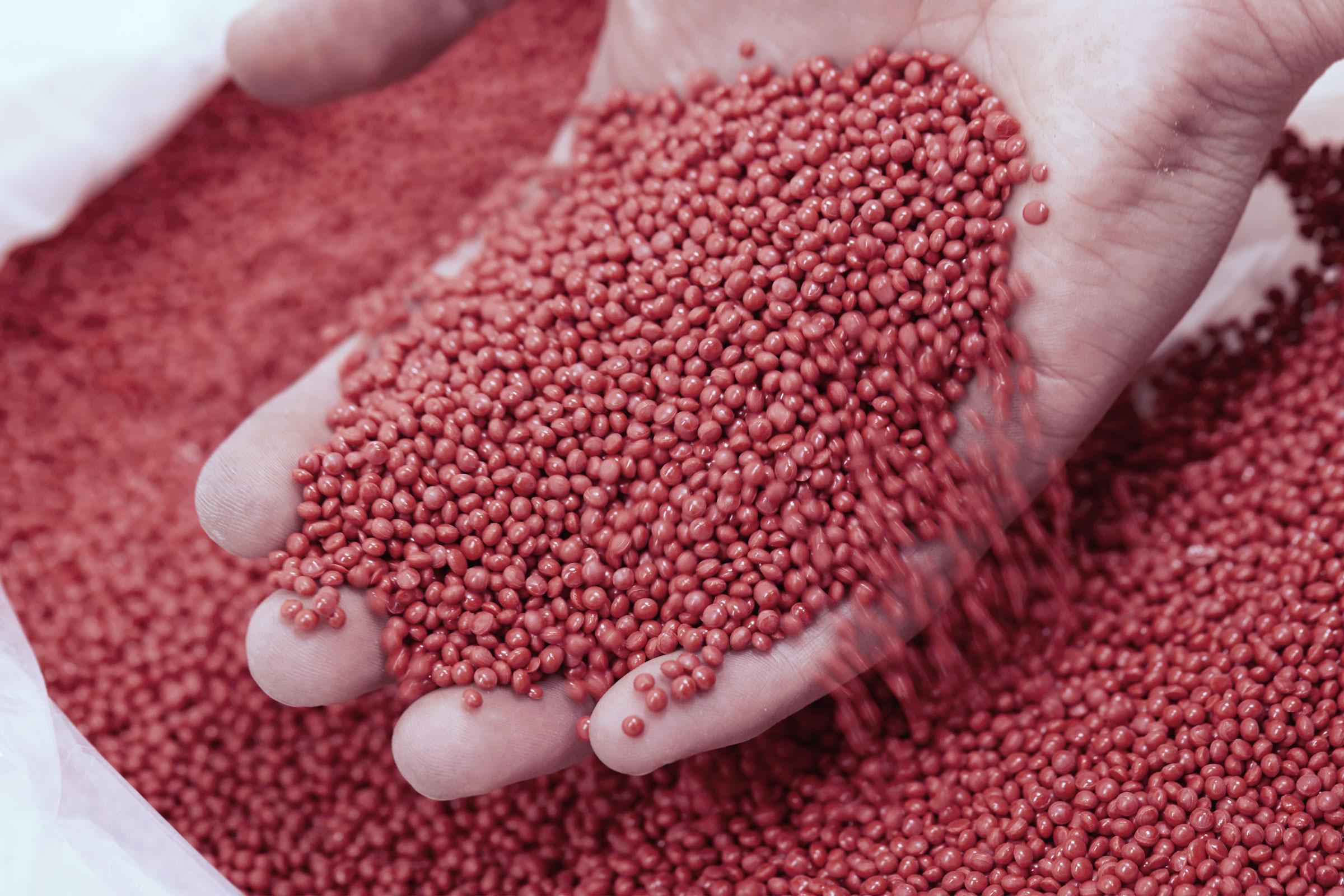
Reinforced Polymer Moulding
What fibres and fillers really do to a plastic, and how to pick the right solution for your part. We select, process and validate reinforced materials so the performance on the datasheet reaches the moulded component.
What “GF30” Means for Your Part
Every filler gives, and every filler takes
Fibres and minerals make a polymer stiffer and stronger, but the effect that reaches the part depends on fibre length, orientation and the coupling between fibre and plastic. The same additives also change shrinkage, warpage, weld line strength and toughness. We look at the whole property balance, not just the headline number on the datasheet, before recommending a material.
Key Highlights
- Short and long glass fibre
- Carbon fibre for maximum stiffness-to-weight
- Natural fibres for lower footprint
- Talc, calcium carbonate (CaCO₃) and mica
- Wollastonite and glass beads
- Impact modifiers to restore toughness
- Gate placement and flow for fibre orientation
- Warpage and shrinkage prediction
Additional Capabilities

Book a free technical consultation
Speak with a manufacturing engineer within 48 hours. Get rapid DFM insights, material guidance, and a clear path to production.
Choosing the right additive for the job
What Reinforcement Gives You
Fibres mainly add stiffness and strength. Platy and spherical minerals mainly add stability. Impact modifiers work the other way round.
- Stiffness
- 3–6×
Typical increase in the moulded part with glass fibre, depending on fibre length and orientation.
- Dimensional Stability
- Higher
Mineral fillers such as talc, mica and glass beads reduce and even out shrinkage.
- Heat Resistance
- Higher
Fibre reinforcement keeps parts stiff at higher service temperatures.
- Toughness
- Balanced
Impact modifiers restore toughness, at the expense of some stiffness.
What Reinforcement Costs You
Design and processing decide the rest
A reinforced grade only performs if the part and the mould are designed for it. These are the trade-offs we review with you before tooling starts.
Fibre Orientation & Warpage
Fibres line up with the flow, so the part becomes stiffer and shrinks differently along and across it. Uneven shrinkage is a common cause of warpage.
Key Tips:
- Place gates so flow runs along the main load direction
- Keep wall thickness uniform
- Consider mineral or hybrid fillers for flat parts
Weld Line Strength
Where two flow fronts meet, fibres do not cross the joint. Weld lines in reinforced grades can be much weaker than the surrounding material.
Key Tips:
- Move weld lines away from loaded areas
- Use flow simulation to predict their position
- Validate critical weld lines with testing
Stiffness vs. Toughness
More filler usually means a stiffer but more brittle part. The right grade balances both for the actual load case.
Key Tips:
- Specify the load case, not just a filler percentage
- Avoid sharp corners that concentrate stress
- Use impact modifiers where impact loads dominate
How Additives Get Into the Material
Fibres and fillers are compounded into the polymer before moulding, with coupling agents that bond them to the matrix. Processing then decides how much fibre length survives.
Key Tips:
- Use the right coupling for the polymer
- Limit fibre breakage with suitable screw and gate design
- Check weight-% vs. volume-% when comparing grades
Need Design Consultation?
Our design engineers can review your parts and provide recommendations for optimal manufacturability and cost reduction.
Numbers to sanity-check a datasheet
Reinforcement Rules of Thumb
Typical values for glass fibre reinforced polypropylene. Actual results depend on fibre length, orientation and processing.
| Property | Value | Tolerance | Description |
|---|---|---|---|
Glass fibre vs. polymer stiffness(×) Material | 25–50 | Stiffness of the fibre itself | |
Moulded part stiffness gain(×) Part | 3–6 | Typical effect reaching the finished part | |
GF30 in PP, by volume(%) Material | ≈13 | 30 % glass by weight |
Mechanical Reinforcement of Polymers
What fibres and fillers really do to a plastic – and how to pick the right solution for your part. A free 30-minute webinar from SP Moulding.